Cows or People


[enlarge]
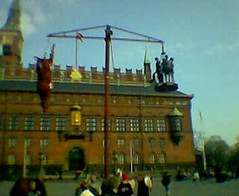
This statue has been raised in front of Copenhagen's Town Hall to protest against the Common Agricultural Policy. I happen to agree. If the third world isn't allowed to trade in agriculture, what else can they trade? A removal of the CAP might hurt western farmers in the short run, but this industry cannot claim a special status anymore. Let the market determine what and where we produce.

Art and Urkraft


[enlarge]

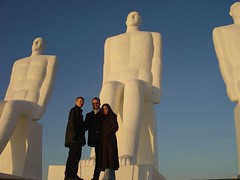
The sun setting on four tall sculptures situated in Esbjerg, all of them identical and staring at the sea. Created by Danish expressionist artist Svend Wiig Hansen.
Elia
I wonder what the giants are waiting for? The revelation of some truth or the end of the world? Maybe it is the same story as for the vanished civilization on Easter Island.

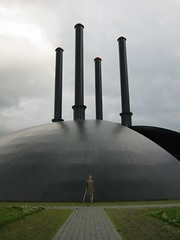
It bears some resemblance to the giant sculpture Elia by Ingvar Cronhammer. Scale, geometry, futurism. One can't help thinking of Mussolini's EUR district in Rome with it's huge entrances, suitable for giants staring at the sea. Elia is also placed next to a medium-sized danish city with ambition, Herning.

These days I am reading a novel by Thomas Pynchon and happened to stumble across Fascist Architecture in Thomas Pynchon. These sites might be the perfect place to improve the reading experience and eat a sandwich.

Refuge


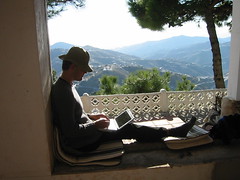
I'm in southern Spain and there's light and warmth. A tranquil place high up in the mountains, perfect for big thoughts.

Living in a Material World

If you can't beat them, join them. In this .pdf I have compiled two items of interest to anyone wanting to nurse their yuppie lifestyle, based in Berlin. A car and an apartment. At the time of writing the DKK/EURO exchange rate was around 7.5, so the car costs around DKK 132.000 and the apartment costs around DKK 2.200.000.

When done shopping furniture for your Berlin-apartment, you can always go and meet your friends in the Liquidrom, listen to underwater music and relax with a healthy mango-drink. Berlin, you are wonderful.

Small-world Networks

In the book "Nexus: Small Worlds and the Groundbreaking Theory of Networks" we return to Stanley Milgrams experiment of sending out letters to random people, asking them to return the letter to a specific person somewhere, under the restriction of sending to personal relations only. This led to the notion of six degrees of separation, that everybody in the world is connected to everybody else in on average six friend of friend-steps.

Later research has shed some additional light on the social structure of human societies. The distribution of the number of relationships people participate in would intuitively follow a bell-curved distribution, as it happens for height and IQ measures. The numbers tell a different story. It follows a power law: A few persons have an enormous social base, while many have a few relations. How is this different from, say, height? In practice, many people might be 1.7 m tall, a few might reach 2.1 m. If height followed a power law we wouldn't be surprised if, now and then, we met some people measuring 4 m or in rarer cases 100 m.

Could this be an argument in favor of viral marketing? Instead of spending resources on mass media, some companies could identify the hubs of our social fabric and start a dialogue.

This kind of marketing has already been raised as an ethical-political issue in Denmark, as some companies have given away brand name clothing to primary school pupils perceived to be associated with high social status.